








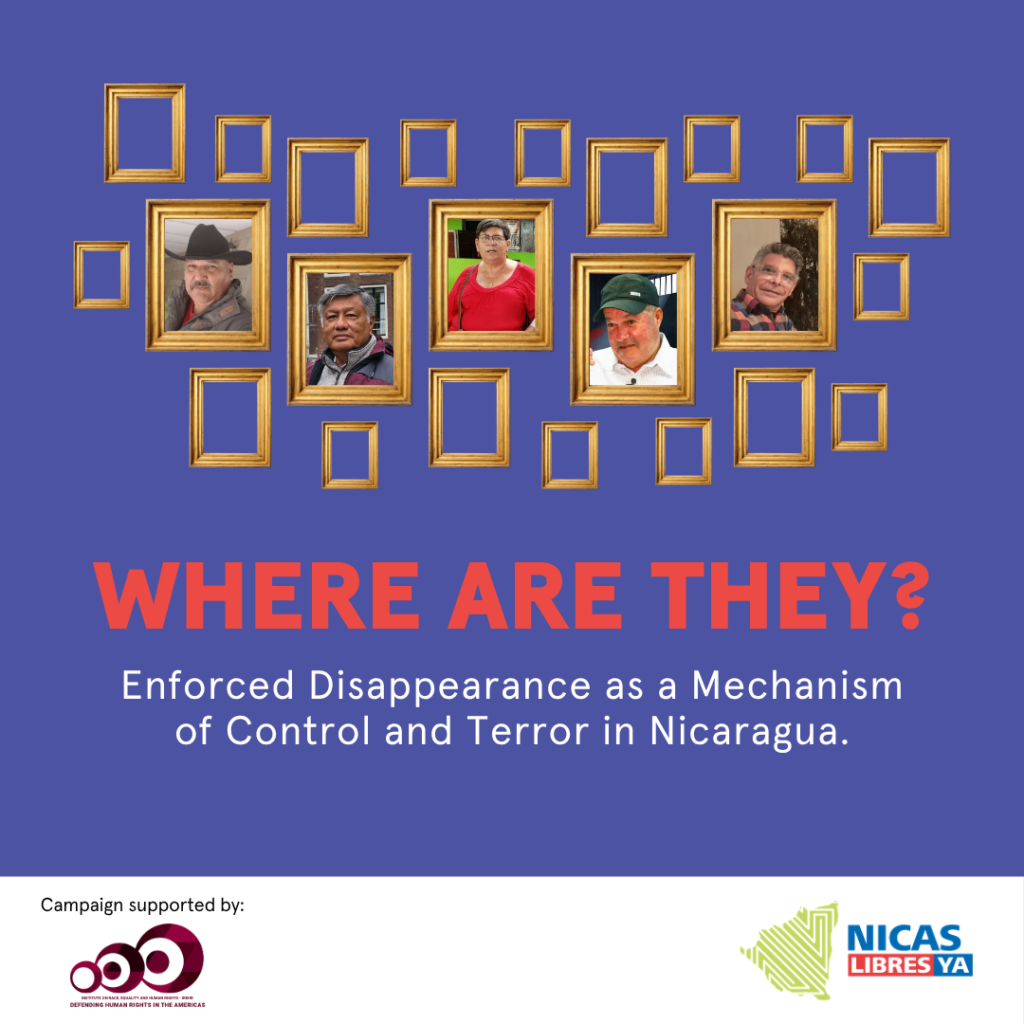
Washington, D.C., August 30, 2026. – “Where are they?” The question echoed on August 6 during the hearing titled “Nicaragua: Enforced Disappearances” before the Inter-American Commission on Human Rights (IACHR), in which a group of organizations presented the situation of people subjected to enforced disappearance—a practice that has become a systematic tool of the Ortega-Murillo regime to exercise social control and sow terror in Nicaragua.
This question was raised by Commissioner Rosa María Payá, the IACHR’s rapporteur for Nicaragua, after hearing details about this form of repression, which, as of July 2026, affected 23 of a total of 60 people arbitrarily deprived of their liberty, according to the latest update from the Mechanism for the Recognition of Political Prisoners in Nicaragua.
Payá directed the question directly at Daniel Ortega and Rosario Murillo, the self-proclaimed president and co-president of Nicaragua, respectively. “Where are they?” he insisted, before naming the men and women who, as of that date, appeared on the list of persons considered to be victims of enforced disappearance: Steadman Fagoth Müller, Manuel Urbina Lara, Víctor Boitano Coleman, Eddie González Valdivia, Douglas Pérez Centeno, Carlos Brenes Sánchez, Salvadora Martínez Aburto, among others.
On August 19, the issue of enforced disappearance was once again addressed during a hearing on provisional measures in the case of Juan Sebastián Chamorro et al. before the Inter-American Court of Human Rights, in which Raza e Igualdad, the Memoria y Justicia Association, the Nicaragua Nunca Más Human Rights Collective, and the Autonomous Women’s Movement, among others, participated. Some of the beneficiaries of the aforementioned protective measures are currently victims of enforced disappearance, including Carlos Brenes, his wife Salvadora Martínez, and the Miskito indigenous leader Steadman Fagoth Muller—all of whom are elderly and, as such, face more serious risks to their lives, health, and personal integrity.
A practice that has been refined
The question “Where are they?” is nothing new to Nicaraguan families. Nor is it new to the organizations that have been documenting this practice since 2018. What has changed is the way the government uses it.
During the hearing before the IACHR, the organizations described how enforced disappearance in Nicaragua has evolved over the past eight years and has become a permanent tool of control and intimidation. This evolution can be observed in three main dimensions: the concealment of a person’s whereabouts, the selective management of information, and the expansion of this pattern to new settings and victim profiles.
Concealment of whereabouts
While in the early years disappearances were concentrated in the first days or months of detention, since late 2023 the concealment of detainees has extended over much of their period of detention. Since 2024, this pattern has been consistently documented in at least 39 cases. Families face a systematic refusal by the authorities to provide information on the whereabouts, health, or situation of their loved ones, and in some cases have been subjected to threats, violence, or demands for money in exchange for information.
The Selective Use of Information
The State no longer needs to deny that a person is being detained in order to keep them in a state of enforced disappearance. It can partially acknowledge the detention while concealing the place of detention, the conditions there, the person’s state of health, or their legal status. So-called “proofs of life”-photographs, videos, or statements released unilaterally-also do not allow for independent verification of these conditions, nor do they guarantee contact with family members, access to a trusted defense attorney, or judicial oversight.
The Expansion of the Pattern
La desaparición forzada también ha alcanzado nuevos escenarios y perfiles. Se han documentado casos que terminan con arresto domiciliario sin esclarecer el periodo de ocultamiento, así como cuatro casos de personas exiliadas en Costa Rica contra quienes se utilizaron solicitudes de extradición y alertas de INTERPOL; en dos de ellos, la extradición fue seguida de detención y desaparición. Asimismo, las víctimas ya no son únicamente opositores, periodistas o defensores de derechos humanos: también incluyen antiguos funcionarios públicos, militares en retiro, jueces, líderes religiosos, familiares de personas perseguidas y personas sin trayectoria pública de activismo.
Enforced disappearance has also taken on new forms and affected new groups. Cases have been documented that end in house arrest without the period of concealment ever being clarified, as well as four cases of individuals in exile in Costa Rica against whom extradition requests and INTERPOL alerts were used; in two of these cases, extradition was followed by detention and disappearance. Furthermore, the victims are no longer limited to political opponents, journalists, or human rights defenders; they also include former public officials, retired military personnel, judges, religious leaders, relatives of persecuted individuals, and people with no history of public activism.
This trend demonstrates that the risk of enforced disappearance is no longer determined solely by a person’s political involvement, but also by how that person is perceived by the state apparatus and by the intimidating effect that their disappearance may have on others. Enforced disappearance has thus become a mechanism of collective intimidation that conveys a message of impunity: anyone can be detained, held incommunicado, or made to disappear.
Brooklyn Rivera: A Disappearance That Ended in Death
The case of Ta Upla Brooklyn Rivera illustrates just how far this pattern can go. The Miskitu indigenous leader was detained in September 2023 and remained a victim of enforced disappearance for more than 970 days. His whereabouts and health status were kept secret until May 27, 2026, when authorities publicly presented Rivera in critical condition and, three days later, reported his death.
But Rivera’s case did not end with him. On May 31, 2026, six of his relatives were forcefully disappeared after being detained for demanding his remains so they could bury him according to their traditions and customs.
Where are they?
On August 30, the International Day of the Victims of Enforced Disappearances, the question posed during the IACHR hearing takes on renewed significance: Where are they?
Douglas Pérez, Centeno, Byron y Alexander Espinoza Flores, Elvia Flores Castillo, Florencia Sarmiento, Glenis Pantin Coleman, Jorge Webster Rojas, Alda López, Santos Rodríguez Lago, Ricardo Mendoza, Larry Martínez, Steadman Fagoth Muller and the other people who are missing, but whose names are not disclosed due to government secrecy and their families’ fear.
Behind every name there is a person, a family, and a story that cannot be reduced to a number. And as long as the government refuses to provide information about their whereabouts and situation, the disappearance continues.
The Nicaraguan government must immediately provide information on the whereabouts and conditions of all persons who have been forcibly disappeared, guarantee their rights, and allow their families to learn the truth.
Because asking, “Where are they?” is also a way to keep them in our thoughts. And as long as there are no answers, we’ll keep asking.
We demand that the Nicaraguan government clarify the whereabouts of the missing persons and release them immediately.
We demand of the Ortega-Murillo regime: Free the Nicaraguans Now!